Wednesday, February 6, 2013

Etisalat and Pacific Controls to Offer M2M Technology for Middle East, Africa and Asia


Etisalat Group and Pacific Controls, the leading global automation company, has announced an agreement to jointly offer unique Machine-to-Machine based (M2M Technology) Sustainable Development applications and support to clients across Etisalat's footprint. This is meant to bring environmentally beneficial, green IT to the Middle East, Africa and Asia covering fifteen countries in total.
The new agreement was signed at a press conference in Dubai by Khalifa Al Shamsi , Chief Digital Services Officer, Etisalat Group and Dilip Rahulan , Executive Chairman of Pacific Controls.
The event was organised to coincide with a visit from the President of the GSM Association (GSMA) Mobile for Development Program, Mr Lawrence Yanovitch and the program's Managing Director Chris Locke . Sougata Nandi , Chief Executive Officer at Pacific Controls, Ahmed bin Ali , Senior Vice President Corporate Communications - Etisalat Group, Abdulla Hashim , Senior Vice President Business Solutions - Etisalat UAE, Dr Shane Rooney , Vice President Machine-to-Machine, Zakarya Alashek Ag. Senior Manager/PM-Mobility Solutions and M2M and other senior management representatives were present for the signing.
"This partnership brings a unique offering that utilizes ICT to deliver sustainable development. It leverages M2M technology to deliver managed energy services and business intelligence in real time, which helps to reduce a company's carbon footprint. We are delighted to be working with Pacific Controls on such a positive goal which shows how mobile and ICT can tangibly benefit the communities in which we live, work and play," said Khalifa Al Shamsi , Chief Digital Services Officer at Etisalat Group.
He continued: "Energy consumption today is at an all-time high, leading to increased ecological and environmental pressure to reduce energy consumption and carbon emissions. As a leader in the telecommunications industry, Etisalat is well positioned to spearhead this initiative in alliance with Pacific Controls, leveraging technologies like M2M to effectively reduce the carbon footprint of the UAE. With this agreement, we are now also able to expand our carbon reduction efforts across our 15 markets."
Dilip Rahulan , Executive Chairman of Pacific Controls, said, "Mankind is facing unprecedented challenge of Climate Change. Pacific Controls' Enterprise City Management Platform, coupled with Etisalat's extensive mobile network coverage, has already manifested that ICT can save the climate at the speed of light. Facilities are reducing their energy costs and carbon footprint by up to 30% through the Energy Star programme that requires only a few days to implement. With real time profiling of energy consumptions, participating organizations are now able to report on their carbon footprint online."
The agreement aims to reduce the carbon footprint of companies across the Middle East, Asia and Africa, and was launched in the UAE in December 2011 as the "Emirates Energy Star".  Since its launch, the programme has eliminated more than 5,000 tons of CO2 emissions in the UAE, achieved purely through active 24X7 Monitoring and Control of the heating, ventilation, and air conditioning (HVAC) equipment across 50 participating facilities, constituting an overall built-up space in excess of 9 million sq. ft.
The overall goal of the Emirates Energy Star programme is to reduce the carbon emissions of the UAE by 20% by 2020. The programme combines the strength of Galaxy software platform, Global Command Control Centre, Subject Matter Experts and Mobile Network to reduce operating costs of facilities.          
Some of the additional benefits offered via the programme is creating business intelligence through data collected and analysed from thousands of devices connected across buildings.
Pacific Control Systems (PCS) provides ICT enabled managed services and converged engineering solutions for buildings and infrastructure projects globally. PCS has pioneered the technology for Smart Cities in which buildings and infrastructure are managed centrally to increase sustainability, leveraging the ICT infrastructure of telecom operators around the world.

Tuesday, February 5, 2013

Austin Okere of CWG Teaches With Authors Steve Blank And Bob Dorf At Columbia


CWG Boss, Austin Okere just back from Columbia Business School, New York, where he participated as an instructor at the Steve Blank “Lean Launch Pad” Class, plans to bring the novel concept to Nigeria.
The Lean Launch Pad is joining forces with Startup Weekend, Udacity, TechStars and Startup America to offer some of the world’s most effective experiential entrepreneurship education.

By combining content from the world’s leading expert in customer development with local mentors and leaders in an intensive flipped-classroom style course, the movement has been able to create a unique, effective experience for teams of entrepreneurs that are serious about growing a customer-driven startup.
The program is already being offered in 15 cities around the world, with another 25 programs launching in February. The goal is to expand the program to more than 100 cities in 2013.  

Thus far, seasoned entrepreneurs such as Steve Blank are teaching NEXT in Silicon Valley, Andy Sack (TechStars Seattle founder) in Seattle, Alex Farcet (founder of Startupbootcamp) in multiple European cities, Eric Koester (founder of Zaarly) in Washington, DC with countless others joining.  
The Eugene Lang Entrepreneurial Center at CBS, where Okere has been a guest lecturer since 2009, conveyed in their invitation their belief that his experience and contribution to entrepreneurial ship in emerging markets will provide unparalleled contribution to the class of aspiring entrepreneurs.

The Computer Warehouse Group, whose case study is a regular feature at Columbia Business School and the Massachusetts Institute of Technology, Boston, as well as many other institutions in Africa, including the prestigious Lagos Business School, chronicles the trials, challenges and triumph of entrepreneurship in the challenging environment that characterizes Sub Saharan Africa.

The Lean Launch Pad course provides real world, hands-on learning on what it is like to actually
start a high-tech company. It is a practical class where the goal is to create an entrepreneurial experience with all of the pressures and demands of the real world in an early stage start up.

The syllabus for the course is drawn majorly from the bestselling book, The Startup Owner’s Manual, co-authored by serial entrepreneurs Steve Blank and Bob Dorf, and the revolutionary new book, Business Model Generation co-authored by Alexander Osterwalder and Yves Pigneur.

These two books provide insights into powerful, simple, tested tools for understanding, designing, reworking, and implementing business models, through a business model canvas, that defines unique value propositions for specific customer segments, and the relationships and channels to deliver these to the customer to maximize revenue. It also helps the entrepreneur identify key resources, partners and key activities to be performed and at what cost.

The course provides a comprehensive step-by-step guide to getting startups right. It walks entrepreneurs through the customer development process that gets them out of the building to develop wining products that customers will buy.

There is an increasing global focus and emphasis on entrepreneurship as the most viable vehicle for job creation. According to the Global Entrepreneurship Monitor (GEM) 2011 report, there is an upsurge in entrepreneurship around the world, with a total number of about 400 million spread across 54 countries. The GEM in its 2006 report revealed that there was a systematic relationship between a country’s level of economic development and its level of entrepreneurial activity. It noted that countries with similar per capita GDP tend to exhibit similar levels of entrepreneurial activity.

At low levels of per capita GDP, industrial structure is characterized by the prevalence of many very small enterprises. As per capita income increases, industrialization and economies of scale allow larger and established firms to satisfy the increasing demand of growing markets and to increase their relative role in the economy.

On his involvement in the Block Week Course at Columbia Business School Okere said “I believe that it is better to have a thousand millionaires than a ten billionaires. It is better still to have a million people with access to a hundred thousand dollars, if they can be taught how to nurture and grow it through entrepreneurial endeavor; and I intend to do something about it, so when I was invited, I did not hesitate in accepting, with a view to bringing the concept to Africa”.

Okere whose entrepreneurial advocacy has taken him on similar teaching expeditions across Africa; through Nigeria, Kenya and Tanzania also remarked “I like to put the story of the Computer Warehouse Group out there because such success stories contribute immensely to the attraction of capital to the region, which combined with the entrepreneurial acumen and the youthful population unleashes waves of economic boom, which in turn lifts the pile at bottom of the pyramid into the more desirable networked economy of the emerging global village. Besides, it provides the perfect opportunity to be a brand ambassador for Africa”.
  
Okere, one of Nigeria’s foremost entrepreneurs has made quite a name for himself over the past 20 years, growing the Computer Warehouse Group into a $130 million revenue company, with 650 staff spread across Nigeria, Ghana, Uganda and Cameroon. In 2012 he was named ICT Man of the Decade by ICT Watch Africa Digital Network, and CWG was named Conglomerate of the Year. The organizers cited CWG’s immense contributions toward the growth and development of Information and Communications Technology (ICT), youth empowerment through ICT education, and nation building.

In 2011 Austin was equally named the ICT Personality of the year by Technology Africa, and the most outstanding ICT Personality of the Decade in 2010 by ICT Watch Africa. He has also received the IT Personality of the Year award by the Nigerian IT and Telecom Awards, among many others.
The Computer Warehouse Group was recently ranked among the top 50 Technology Companies in West Africa, and also bagged the Award of the ICT Company of the Year 2012 by Technology Africa.

Okere who shall be participating at the Economist Group’s Nigerian Summit in March intends to take his entrepreneurial advocacy very strongly to the Forum to attract the much needed focus.

Thursday, January 31, 2013

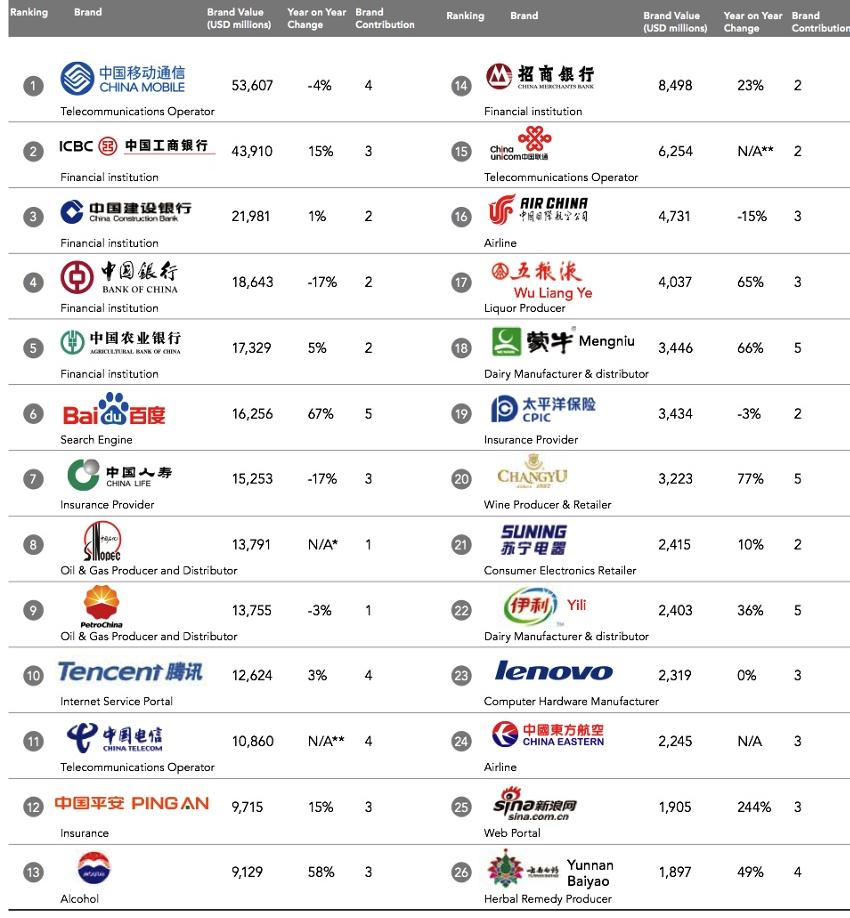
14 Tech Giants make China’s Top 50 Brands List


The market research firm Millward Brown has just released the 2012 edition of its ‘BrandZ most valuable Chinese brands top 50’ report. It sees more Chinese tech firms that ever on the list, including well-known names in social media.

Indeed, some tech brands are growing most quickly in terms of what’s called “brand value” – that’s a measure used by some analysts derived from a company’s ability to generate demand, based partially on forecasted earnings. The report’s authors note that “this explosion of [brand] value suggests the enormous influence that Chinese brands exert and their potential impact on markets worldwide.”
One successful example is the local manufacturer Haier, who launched a mini-site about energy conservation to coincide with Earth Hour. Chris Maier, the research company’s director of digital media, notes:
Haier’s Earth Hour website received over 1.5 million visitors after only 10 days online, indicating the success of social media as a platform for Haier to spread its message of promoting a smarter life for a better planet. Importantly, the Earth Hour initiative is very much in line with Haier’s renewed brand positioning as a developer of sustainable white goods solutions and producer of environmentally responsible and energy efficient appliances.
It’s that kind of engaged marketing that saw Chinese tech companies do especially well in terms of their own brand value.


Wednesday, January 30, 2013

Oracle Call Sun Acquisition A Good Deal...accused of neglecting inherited consumers


Oracle is close to resuming growth in its hardware business, according to Oracle executives who, three years after spending $7.4 billion to buy Sun Microsystems, say the acquisition has more than paid for itself.
"The cash flow has far exceeded the value" of what Oracle paid for Sun, Oracle president Mark Hurd said in response to a question during a conference call with journalists recently.
Hurd also said the technologies that came with the acquisition, including Java development tools and server hardware, have helped the company develop new products. The most obvious example is Sun's server technology, which forms the foundation of the company's "Engineered Systems" products, including the Exadata and Exalogics servers and the SPARC SuperCluster servers.
Oracle's hardware sales have been steadily declining since Oracle bought Sun three years ago. In the second quarter ended Nov. 30, Oracle's hardware systems sales declined 23 percent year-over-year to $734 million, accounting for 8 percent of the company's total sales.
When revenue from hardware systems support is added to the mix, hardware accounted for a little over $1.3 billion in second-quarter sales -- about 15 percent of total revenue for the quarter.
Oracle executives have maintained that hardware sales are declining as the company discontinues sales of commodity server products, focusing instead on value-added products such as the Engineered Systems that combine hardware with Oracle software. Oracle also discontinued OEM sales of several storage system products from other vendors, focusing instead on the Sun ZFS line of storage products.
"We've been very particular and deliberate to focus on our value-add strategy," Hurd said during the media call Monday. He said Engineered Systems saw 70 percent sequential growth in sales bookings in the second quarter.
When asked when hardware sales would resume growing, Hurd said: "We're right about at that crossroads." That echoed statements by CEO Larry Ellison on the second-quarter earnings call in December when he said the company was "just about finished with the downsizing phase" and about to "start growing our hardware business.
Meanwhile Java has continued to prove a security nightmare for years. Part of the problem, as observed by InfoWorld Security Adviser Roger Grimes, is that companies neglect to turn off Java or to even roll out security patches as they emerge. The reason: "It's the number of mission-critical enterprise apps tied to specific Java versions. In case after case, IT security people say they can't patch Java in a more timely manner because doing so breaks too many vital applications."
Can Java be repaired, though? More important, has Oracle made an effort to find out? Krebs raised that very question as he called out the company for being negligent of the customers it unwittingly acquired when it consumed Sun in 2010:
"I feel strongly that Oracle is an enterprise software company that -- through its acquisition of Sun Microsystems in 2010 -- suddenly found itself on hundreds of millions of consumer systems. Much of the advice on how to lock down Java on consumer PCs simply doesn't scale in the enterprise, and vice-versa. Oracle's unprecedented four-day turnaround on a patch for the last zero-day flaw notwithstanding, the company lacks any kind of outward sign of awareness that its software is so broadly installed on consumer systems. Oracle seems to be sending a message that it doesn't want hundreds of millions of consumer users; those users should listen and respond accordingly".
Zsolt Sandor, a veteran Java developer, said until Oracle gives Java a much-needed thorough code review, browsers makers should develop a Java applet whitelist, such that browsers simply would not allow unapproved applets from executing. "This would solve the 99.9 percent of the cases until the code review is made, and fixes are done," he wrote.

Tuesday, January 29, 2013

Samsung, Microsoft show-off With Bendable Screens @ CES 2013

Samsung, at CES 2013, showed off several in-development Youm smartphone and tablet screens made of thin, bendable plastic, rather than glass. Samsung, as promised, used its time on stage at the 2013 Consumer Electronics Show to show off bendable-screen technology that's being developed with future smartphones, tablets and more in mind. Microsoft was also on hand, showing a research project for its Xbox Kinect that makes video games look like they extend beyond the edges of a TV screen onto the walls and floor.
The displays will be marketed under a new brand called "Youm," which "doesn't just bend the rules of display technologies," a delighted Stephen Woo, president of Samsung Device Solutions, told the audience during the show's final major keynote. "It completely rewrites them."
Brian Berkeley, senior vice president of the Samsung San Jose Display Lab, showed off two Youm products. The first was a seemingly hard little square, out of which came a thin, bendable piece of plastic—roughly the size of a smartphone display—that acted as a crisp, bright screen on which advertising was running. The plastic moved like a thick photo negative, bending one way and the other and capable of being rolled up, but not designed to be bent.
Organic light-emitting diode (OLED) displays compete with liquid crystal displays (LCDs). OLEDs, said Berkeley, deliver a superior image quality, with "much deeper blacks and more vivid colors." They're also super-thin and lightweight, he explained, and because they produce their own light, they don't need a backlight, which adds weight and depth to a device.
"Now, they can be flexible, as well," said Berkeley, adding, "Our team was able to make a high-resolution display on extremely thin plastic, instead of glass, so it won't break, even if it's dropped." Berkeley returned the first device to a large display area on the stage and then—smiling and pausing for a moment, like a knowing, tech-world Neil Armstrong about to take a leap for mankind—pulled from his pocket a small, tablet-like device, which featured a screen that wrapped around the side of the device.
"With this bended display, we have expanded the canvas available for content. Content can now flow along the sides of the device," said Berkeley. "If I receive an important message, I can see it come through while the device is flat on the table in front of me. ... It opens up new lifestyle possibilities ... and will allow our partners to create a whole new ecosystem of devices with blended, foldable and rollable screens."
Woo then cued a playful short film in which Samsung offered ideas about products that might emerge from the technology. One device looked similar to the Samsung Galaxy S III smartphone—and could indeed be used as a phone—but was actually something of a sandwich that, when opened and set down flat, became a tablet with twice the viewing area of the smartphone.
Microsoft is also getting in on the act. Eric Rudder, its chief technology strategy officer, came on stage to show a Microsoft Research project called IllumiRoom, which builds on its Xbox Kinect and projects light on the walls and floor of a room, to make video games look like they extend beyond the edges of the screen.
A second device resembled a thin digital recorder—or even the Nokia "lipstick phone," for those with long memories. When it rang, its fashionable young owner touched a button that sent a large, thin display—much like the one Berkeley showed off, but bigger—shooting out the side. The devices won each of their owners—the second replacing the first at a busy cafe table—the attentions of a pretty patron sitting close by. Nokia and Apple have also been connected to reports of flexible screens. Whichever company can bring one to market first is likely to win.

Friday, January 18, 2013

BrandIndex gives Microsoft, Bing and Windows thumbs up...as BBC, Google, Apple, brands drop in U.K. ranking

The BBC, Google, Apple and Amazon.com are among big media and Internet brands whose reputation in Britain was dragged down by negative buzz this year, according to annual brand ranking data from YouGov's BrandIndex. But the BBC iPlayer, the public broadcaster's digital TV catch-up service, topped the U.K. list of brands with the biggest positive buzz in 2012, according to the Guardian. It hit a score of 30, a figure reached when calculating the percentage balance of people saying that they have heard good things versus people reporting having heard bad things.
The BBC suffered from the Jimmy Savile sexual abuse scandal this fall and a report by its flagship TV news magazine that wrongly implicated a former politician in another abuse case. "While the BBC umbrella brand is definitely being hit and is at the lowest levels ever seen, there has been no knock-on effect for products like the iPlayer and its .co.uk web site," which ranks 8th on the list, said BrandIndex director Sarah Murphy.
Google, which ranked fourth last year with a score of 26.7, dropped out of the top 10 as its score fell by 15 points, while Amazon fell from the top spot in 2011 to the third rank this year, according to the list.
Apple's reputation also took a hit amid criticism of its new mapping software, mixed reviews for the iPhone 5 and legal battles with rival Samsung, which took the 9th rank on the list. Apple dropped out of the top 10 after reaching the sixth spot last year, with its score falling from 24.6 to 15 points. But its iPad came in sixth thanks to positive buzz for tablets.
The Guardian said the YouGov researchers cited public anger in the U.K. amid a recent debate over measures by the likes of Google, Amazon and Starbucks to avoid taxes as a key factor hurting the scores of those companies. Murphy said: "Amazon had a score of 32.1 last year, so a fall of eight points [to 24.1] is a statistically significant drop for them." In the case of Google, its brand buzz was also negative amid a change in privacy policies that have sparked a European probe. The research firm asked 2,000 people every day if they had heard anything positive or negative about a slew of brands.
According to brand perception rating agency, BrandIndex, Microsoft is experiencing one of its biggest US consumer perception surges in two years, likely riding the wave of multiple initiatives including Bing’s current advertising campaign, the recent launch of Windows 8, and its new Surface tablet.
For Microsoft, their product stars seem to have aligned at roughly the same time:
  • Search engine Bing reached a two-year high in consumer perception.
  • The Windows brand is at its highest perception point since the introduction of Windows 7 in October      2009.
  • Microsoft is getting its best perception marks of the year from tablet owners.
Microsoft, Bing, and Windows were measured with YouGov BrandIndex’s Buzz score, which asks respondents: "If you've heard anything about the brand in the last two weeks, through advertising, news or word of mouth, was it positive or negative?" Results were divided into two groups: all adults age 18+, and all adults age 18+ who own tablets.
Since mid-October 2012, Microsoft perception has risen from 17 to 25. Among tablet owners, the brand enjoys even better perception levels, moving from 23 to 33 over the same period. Bing has also enjoyed steady improvement with consumers overall, moving from 10 to 16 within the same period. This represents its highest Buzz score in over two years and coincides with Bing's current advertising campaign.
Since Windows 8 promotions kicked in at mid-October last year, the Windows brand has seen its buzz score rise from 14 to 23. That is the brand’s highest buzz score since the launch of Windows 7. And with tablet users, the Windows brand rose to a 30 score the first week of November same year. It's expected that this trend will reflect on Microsoft Q1 results of 2013.
BrandIndex is the authoritative measure of brand perception. Unlike any other brand intelligence services, BrandIndex continuously measures public perception of thousands of brands across dozens of sectors.

Tuesday, January 15, 2013

Localphone.com Offers Discounted SMS Messages to Nigeria


International calling and SMS provider, Localphone.com, is rewarding customers with discounted rates to send SMSs to Nigeria.
Localphone customers can save even more money next week by sending cheap texts to Nigeria in the Localphone January sale.  The calling and SMS provider will be offering a 25% discount off the price to SMS Nigeria for a whole week.  
During the promotion the new rate to send a text to Nigeria will be 3.5¢ USD / 2.3p GBP or 2.5c EUR per message and therefore making Localphone one of the price leaders in the market for sending texts to Nigeria. The 25% discount will run from 12pm GMT (noon) 14th January until 12pm GMT (noon) 21st January.
CEO and founder of Localphone, Paul Cusack, commented, ‘The January sales are happening at the moment and Localphone is pleased to offer discounted SMS to Nigeria; one of the most popular SMS destinations for Localphone customers. We hope they enjoy the offer and remember to send texts to their friends recommending Localphone.’
Localphone offers a pay-as-you-go service with no monthly fees or contracts, so any new users who are not yet Localphone customers can still take advantage of the offer by signing up for a free account at http://www.localphone.com/sms/nigeria.
Localphone.com was established in 2007.  It is headquartered in Sheffield, United Kingdom and has quickly grown to become one of the world’s leading providers of cheap international calls and SMS.  As well as providing customers with cheap calls and SMSs the company has a range of services to suit the different needs of its target markets, from VoIP calls to Incoming Numbers and calls from its Desktop and Smartphone apps.  
The company was recently awarded Highly Commended for Best Consumer VoIP at the ITSPA 2012 Awards, and with lots of new features and services in the pipeline 2013 looks set to be an exciting year for Localphone.

MTN’s Potential Exit from Nigeria: Examining the Impact of the Proposed 5% Telecom Tax

MTN Nigeria, the largest telecom provider in the country, has hinted at the possibility of exiting the Nigerian market should a proposed 5% ...